.svg)


By: Renee Lackey, MA, NCC, LPC-MHSP (T)
The Power of Narrative Begins with Us
When a child or teen walks into therapy, they are not just stepping into a room—they’re stepping into a story. And whether we realize it or not, we become co-authors of that story. Our words, tone, and framing shape how that child comes to see themselves: not just in that moment, but for years to come.
Language is more than a tool for communication. It’s how we assign meaning to experience—and for children and adolescents, meaning becomes identity. As a child and family therapist, I’ve seen how pivotal this distinction is. Children and adolescents are incredibly perceptive. They don’t just listen to what we say—they internalize it, carry it, and often build their identity around it. That’s why it's essential that both therapists and caregivers start from this core belief:
There is nothing wrong with you. Not now. Not ever.
From Labels to Language of Compassion
All too often, therapy is framed—subtly or explicitly—as a corrective space. A place kids are sent when they’ve done something wrong, when they “can’t behave,” or when they “need to be fixed.” Even when well-intended, this framing plants seeds of shame.
But we can choose a different narrative.
Instead of saying, “You need help,” what if we said, “Therapy is a place where we get to learn about what’s going on inside you”? Instead of, “You’re being bad,” we say, “You’re having a hard time right now.” Dr. Becky Kennedy, known for her “Good Inside” philosophy, reminds us that children are inherently good—even when they’re struggling. That’s the message we must reinforce consistently.
Welcoming Every Part of the Child
Children are not one-dimensional. Their behaviors, fears, and outbursts are often expressions of complex inner worlds. Rather than labeling a child as anxious or defiant, we can begin to explore the parts of them that are showing up. Dr. Richard Schwartz’s Internal Family Systems (IFS) model provides a deeply compassionate framework: each child has parts—some protective, some reactive, some hurting—and all of them are trying to help in their own way. None of these parts are bad. They each serve a purpose, and they all deserve to be heard.
So when a child lashes out or shuts down, we might say, “It sounds like a part of you feels really scared,” or “A part of you is trying to keep you safe.” This kind of language helps children understand that they are not their behaviors—they have behaviors. They are not their feelings—they have feelings. That distance fosters self-compassion, and self-compassion fosters healing.
Words That Shape the Brain
Neuroscience supports what so many clinicians intuitively know: the way we talk to children shape their brains. Dr. Dan Siegel’s “Name It to Tame It” strategy shows that when children are guided to name and understand their emotions, they move from overwhelm to integration.
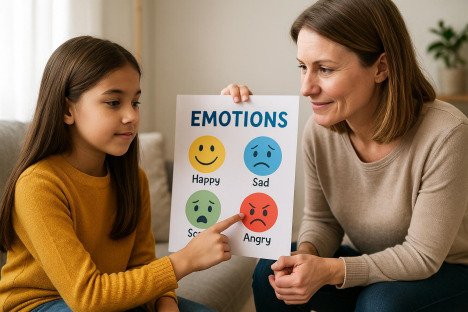
Siegel emphasizes that helping kids tell a coherent story of their emotional experiences builds resilience. It helps them understand themselves from the inside out—reducing fear, increasing regulation, and ultimately, supporting their sense of self-worth.
Connection Before Correction
Beyond words, children are wired for connection. Lisa Dion’s Synergetic Play Therapy approach shows that what heals isn’t a script—it’s attunement. When we, as adults, stay emotionally regulated and present, children feel safe to express even their most painful or chaotic emotions.
This kind of relational safety can’t be overstated. Whether it’s during play, conversation, or a meltdown, what matters most is that the child senses, “You’re with me. You’re not trying to change me. You’re trying to understand me.” That kind of presence is the soil where trust—and healing—grow.

Reframing the Role of Caregivers
Parents and caregivers play a vital role in reinforcing the messages children internalize. A recent study in Frontiers in Psychology found that parent-implemented language interventions significantly improved expressive skills and emotional understanding in toddlers. When caregivers learned to respond with warmth, curiosity, and expansiveness, children didn’t just talk more—they felt more secure.
This tells us something crucial: healing doesn’t just happen in therapy sessions. It happens around dinner tables, in bedtime routines, and during car rides to school. The words we choose in everyday moments shape how children view themselves—and whether they see therapy as a punishment or a gift. And that security becomes the foundation for emotional regulation and self-confidence.
Long-Term Impact: What They Believe About Themselves
We have to remember: the stories children believe about themselves don’t end when the therapy session ends. If they walk away believing they are “too much,” “not enough,” or “broken,” those beliefs often show up later as people-pleasing, self-sabotage, anxiety, or isolation. They may grow into teens and adults who feel ashamed of needing help, who equate struggles with failure, or who silence their own needs to avoid judgment.
But if they internalize instead: “ I am not broken. I am brave for being her. I have parts of me that need care, not shame,” they carry a resilience that lasts. They become teens and adults who seek help when needed, who speak to themselves with kindness, and who believe they are worthy of love exactly as they are.
Language to Use, Right Now
Here are some affirming phrases that gently reshape a child’s narrative in everyday interactions:
• Instead of “Be good,” try: “Remember, you’re good inside. Let’s figure out what’s getting in the way.”
• Instead of “You’re acting out,” try: “A part of you is having a hard time right now.”“You’re not being bad—you’re having a hard moment.”
• Instead of “You need help,” try: “Therapy is a place where we learn more about what you need and how we can support you.”
• Instead of “You need to work on your behavior so you can be a good kid,” try: “You don’t have to be fixed—you're already enough.”
• Instead of “Why are you crying again?” try: “It makes sense you feel this way.”

Every Word Matters
As therapists and caregivers, we are in the business of holding space—not solving problems. And in that space, the language we use can either affirm a child’s wholeness or fracture their sense of self.
Let’s be intentional. Let’s use our words to reflect back the truth that every child deserves to know:
You are not broken. You are brave for being here. And you are worth understanding.
What Story Are You Telling?
Pause and reflect:
What are your words telling the children in your care about who they are?
Choose language that affirms rather than fixes, that explores rather than labels, and that welcomes every part of their being. Because what we say becomes what they believe. And what they believe shapes who they become.
References
• Beitchman, J. H., et al. (2001). Fourteen-year follow-up of speech/language impaired and control children: Psychiatric outcome. Journal of the American Academy of Child and Adolescent Psychiatry, 40(1), 75-82.
• Schwartz, R. C. (2001). Internal Family Systems Therapy. Guilford Press. • Siegel, D. J., & Bryson, T. P. (2011). The Whole-Brain Child. Delacorte Press. • Kennedy, B. (2021). Good Inside. Harper Wave.
• Dion, L. (2023). Synergetic Play Therapy. Synergetic Play Therapy Institute. • Gómez, A. M. (2013). EMDR Therapy and Adjunct Approaches with Children. Norton.
• Fenson, L., et al. (2021). Parent-implemented language interventions: A review. Frontiers in Psychology.
• “Internal Family Systems: The Teenage Part.” LinkedIn, March 2025. • “Play Therapy for Trauma Recovery.” The Guardian, April 2025.
• “The Neuroscience of Mindfulness.” Dr. Sarah Bren Podcast, 2022.
About the Author:
Renee Lackey, MA, NCC, LPC-MHSP (T), is a child and family therapist in Brentwood, Tennessee, who helps parents and children turn everyday struggles into moments of connection and growth. She specializes in trauma-informed care for children, teens, and families working through anxiety, grief, divorce, and behavioral challenges. With a Master’s degree from Northwestern University and advanced training in EMDR and Play Therapy, Renee combines research-backed tools with a heartfelt, relational approach. She helps parents move beyond power struggles, teaching practical strategies for co regulation and emotional connection, and guiding children to build resilience and healthier coping skills. Renee offers both in-person and virtual sessions, creating a safe, supportive space where families can heal, grow, and feel more connected.
Call or text: (615) 861-9977
Email: therapywithrenee@proton.me


.avif)

.avif)

.avif)
.avif)